Being useful is not the same as having worth
AI is making usefulness cheap. Most of us never noticed how much of our worth we'd kept there.

More and more, I watch AI and agents doing work I used to do.
Not the dull parts. I could live with that. It’s the work that gave my job its meaning, the work that needed my expertise. At least part of my expertise.
I’ll say up front where I’m coming from. I think most of us have been keeping our sense of worth somewhere we never chose: in being useful. As long as we were needed, we never had to look closely at that arrangement. AI is making usefulness cheap. And I don’t think we’ve noticed what that does to the thing we stored there.
Maybe I’m wrong. Part of it, I’ll admit, is that I don’t like the feeling. But I’ve been trying to work out why it bothers me, and that’s what this essay is about.
The question we keep not asking
When people talk about AI and work, the question is almost always about the machine. What can it do? How fast is it? How much does it save?
The question we rarely ask is about us. When it does the part of the work that made us feel needed, what’s left? And who are we when it’s gone?
Here’s an imagined version of how that question arrives.
Mara has worked in a claims team for years. Over six months, agents take over the simple work, then the documentation, then the first round of assessment. Each step makes sense on its own. By the end, she can clear her queue before lunch. At her annual review, her manager closes the laptop and asks, kindly, “What do you bring to this job now?”
She opens her mouth and nothing comes out.
Mara didn’t fail to prepare. Her manager didn’t ask a new question. He asked the one her job had been quietly answering for her for years. The agent just stopped it answering.
That’s what I mean by keeping our worth in our usefulness. You don’t see the arrangement until something else becomes useful in your place.
The good answer is the dangerous one
There is a good answer available, and it’s worth taking seriously.
MIT Sloan researchers Isabella Loaiza and Roberto Rigobon turned the usual question around. Instead of asking what AI can do, they asked which human capabilities complement what it can’t. They grouped them under the acronym EPOCH: empathy, presence, opinion and judgment, creativity, and hope. Using nearly 19,000 work tasks from the US O*NET database, grouped into 750 clusters, they found that tasks relying more on these capabilities were associated with employment growth between 2016 and 2024. Hope showed the strongest link, followed by opinion. (MIT Sloan)
Rigobon is pointed about the language. “We deliberately don’t call these [human skills] ‘soft’ skills,” he said. “A ‘hard’ skill, like solving a math problem, is comparatively easy to teach. It is much harder to teach a person these critical human skills and capabilities.” (MIT Sloan press release)
So Mara could have answered. The claimant who needed someone to stay on the line. The broker who trusts her. The claim that met every rule and was clearly wrong. It would have been a good answer, and her manager would have typed it into the box.
But look at what that answer agrees to. Every item on the list answers the same question: what can you do that the agent can’t? The better your list, the more completely you have accepted the agent as the measure of you. You aren’t describing your worth. You’re describing the gap. And a worth that depends on a gap lasts only as long as the gap does.
That’s the trap. The good answer is the dangerous one.
What we lose before we lose the job
The usual fear is losing the job. I think something else can go first.
In the 1980s, the social psychologist Marie Jahoda asked what work gives people besides money. Her answer was five things: a structure to the day, contact with people outside the family, status, regular activity, and collective purpose, which researchers describe as the sense of being useful to other people. A 2023 meta-analysis found that unemployed people report less of all five, and that each one independently predicts mental health. (Paul et al., 2023)
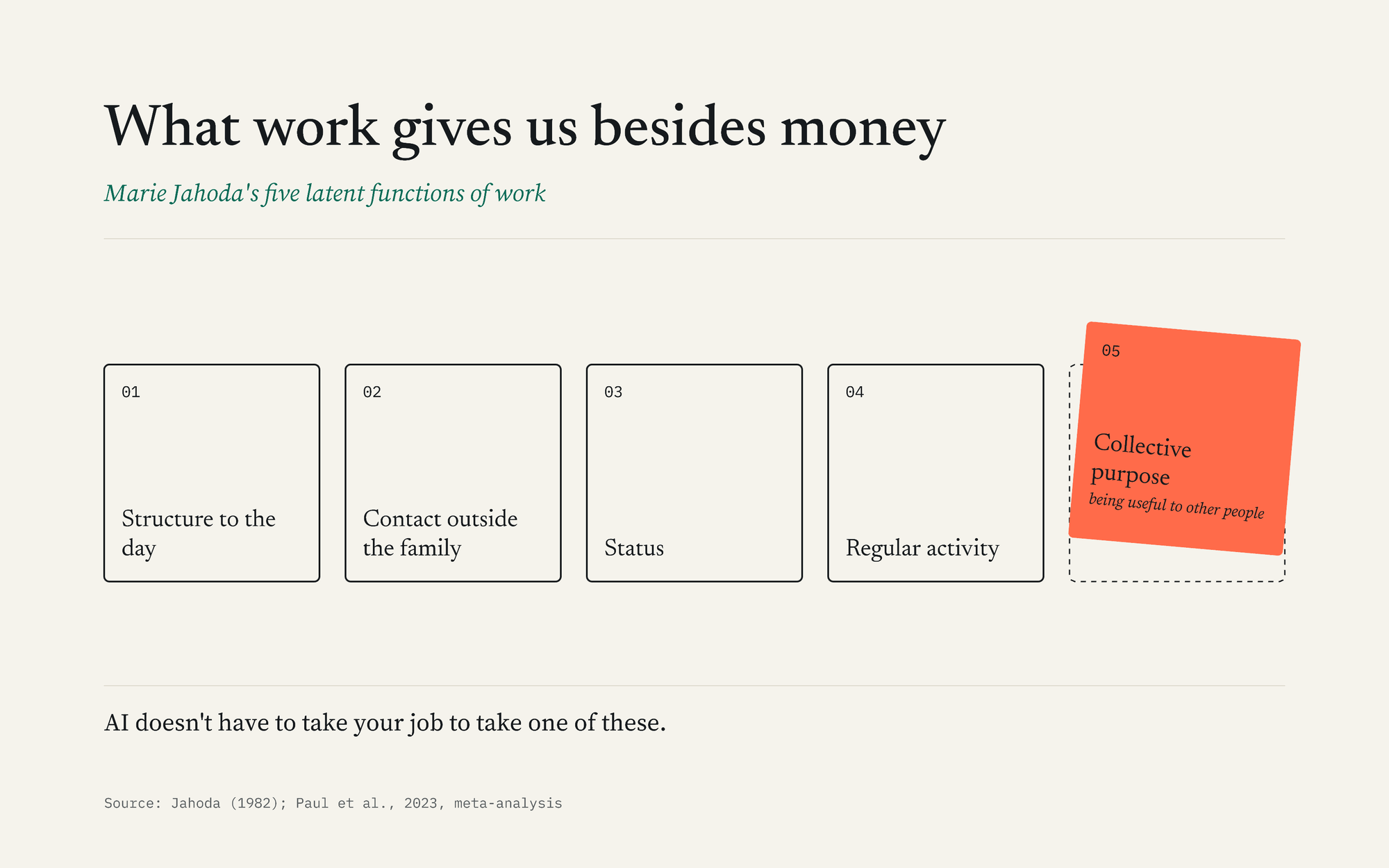
Those studies are about people who lost their jobs. Here’s what bothers me. AI doesn’t have to take your job to take one of those five. It can leave you the title, the desk, the salary and the calendar, and quietly take the part where you were needed.
You can keep the job and lose the point of it.
If that sounds abstract, try it on. Think of the part of your work you’d most hate to hand over. Not because of the hours, but because it’s the part where you feel like you. Now imagine it’s done before you arrive, and done well.
Price and dignity
Immanuel Kant drew a line that helps here. Everything, he wrote, has either a price or a dignity. What has a price can be replaced by something equivalent. What is above all price, and has no equivalent, has dignity. (Philosophy Now)
Most of working life is a pricing exercise, and for a long time it didn’t feel like one. Replacing a skilled person meant a long search and years of training. That slowness gave our work a kind of shelter. It was easy to mistake the shelter for dignity.
AI removes the shelter. When the alternative can be scaled up by Thursday, the price becomes visible. It was always there.
Your worth has been on loan from your job. You find out the terms when the loan is called in.
The strongest objection
The best argument against me comes from the philosopher Michael Sandel. In The Tyranny of Merit, he argues that “the fundamental human need is to be needed by those with whom we share a common life”, and that the dignity of work lies in using our abilities to meet those needs. Losing a job, on this view, isn’t just losing income. It’s losing the chance to contribute to the common good. (Sandel in The Atlantic, 2020; summary in Philosophy of Management)
If Sandel is right, then separating worth from usefulness is a comfort for people whose usefulness is still secure. Being needed isn’t a shallow measure of a person. It may be close to the heart of a good life. Telling someone “your worth isn’t your output” can sound like a pat on the head.
I take this seriously, and I think it’s mostly right. But notice what it does to the argument. If being needed is that close to the core of us, then the threat is bigger than I said, not smaller. The question stops being whether usefulness matters. It becomes who decides what counts as being needed. And right now, the benchmark being set for every one of us is a machine.
There’s also a fair defence of Mara’s manager. A review measures contribution, not worth, and jobs are allowed to change. Pretending a role hasn’t shrunk would be the unkind thing. True. But that is exactly why we can’t leave the question of worth to the review. It was never designed to answer it.
What I’m watching for
I’m not arguing against AI doing work. I’m watching for something more specific.
I’m watching for the moment we start describing people by what’s left over: the human remainder, whatever the agent can’t do yet. Once we talk that way, we’ve already agreed to the measure.
I’m watching whether organisations redesign roles so that people are still needed by other people, or simply let the meaningful parts drain away and call what remains efficiency.
And I’m watching myself. Every time I feel relieved that an agent can’t do something I do, I ask what I’m actually relieved about.
Here’s a test, if you want one. Write down what you bring, without mentioning anything a machine can or can’t do. Most of us stop after a line or two. That pause is the question this essay is about.
AI didn’t create the question. It made it cheap to ask. So who gets to answer it for you?
Mara and her review are imagined. The research cited is real.